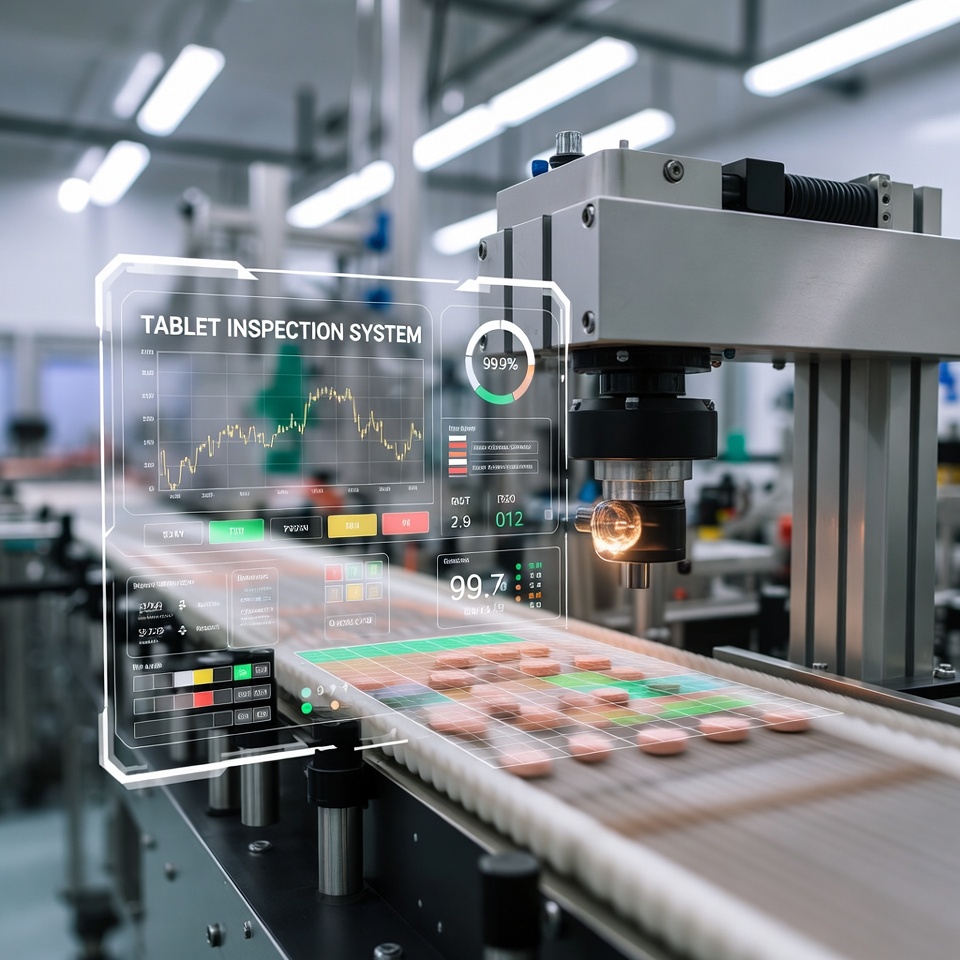
Human visual inspection has been the gold standard in pharmaceutical quality control for decades. But AI-powered computer vision systems are now achieving accuracy rates that exceed human capabilities—detecting defects invisible to even the most trained inspectors—as Pharma 4.0 adoption accelerates in 2026.
The Limitations of Human Inspection
Traditional visual inspection faces inherent challenges: inspector fatigue reduces accuracy by up to 30% during extended shifts, consistency varies between individuals and across time, and certain defect types—microscopic cracks, subtle color variations, dimensional deviations under 0.1mm—simply cannot be reliably detected by human eyes.
How Computer Vision Changes the Game
Modern pharmaceutical AI vision systems combine high-resolution cameras with deep learning algorithms trained on millions of product images. These systems inspect 100% of products at production speeds, detecting defects with 99.9%+ accuracy while simultaneously documenting every inspection for regulatory compliance and reducing false rejects through advanced differentiation (e.g., glare vs. crack, bubble vs. particle).
Key Capabilities
- Detects surface defects, cracks, contamination, and cosmetic issues at microscopic levels
- Identifies fill-level variations with sub-ml precision
- Verifies label placement, print quality, OCR/OCV for lot/expiry/barcodes, and correct product-package matching
- Operates 24/7 with consistent accuracy regardless of environmental conditions or fatigue
Real-World Implementation Results
Industry implementations of computer vision for tablet inspection across production lines have demonstrated strong results within the first six months: up to 47% reduction in customer complaints, 80–90% decrease in batch rejections due to false positives, multi-million-dollar annual savings from reduced waste, and complete automated documentation for FDA audits—outcomes consistent with published benchmarks for AI-enhanced visual inspection in pharmaceutical manufacturing.
Integration with Existing QC Processes
Successful implementation requires strategic integration with current quality systems. The vision system outputs integrate directly with batch records, statistical process control, and MES platforms. Human inspectors transition to exception handling, system oversight, and validation roles. Validation protocols follow FDA Computer System Validation (CSV) guidelines and risk-based approaches, with comprehensive IQ/OQ/PQ documentation and traceability for audits.
The Path Forward
Computer vision in pharmaceutical QC isn't about replacing human judgment—it's about augmenting human capabilities with technology that never tires, never blinks, and sees what humans cannot. The question for pharmaceutical manufacturers isn't whether to adopt this technology, but how quickly they can implement it strategically to maintain competitive advantage, reduce recalls, and ensure product quality in a highly regulated environment.